Jane Eyre Close Reading Passage Vol 2
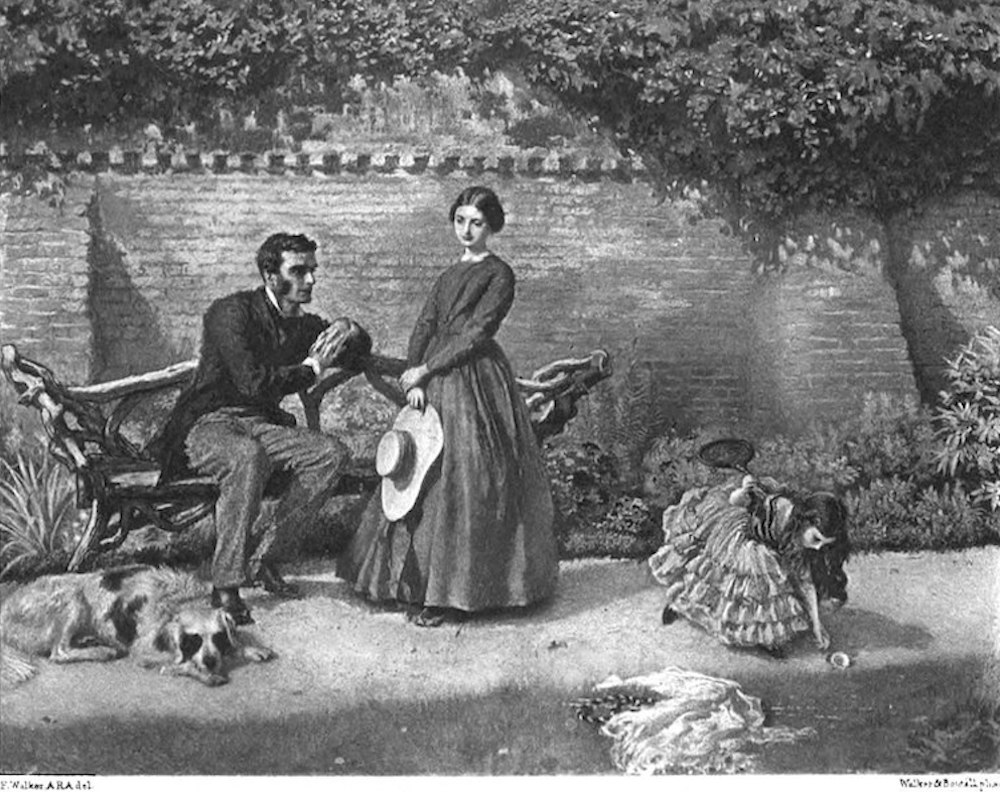
Frederick Walker, A.R.A., Rochester and Jane Eyre, 1899. Public domain, via Wikimedia Eatables
The summer that I did my chaplaincy internship was a wildly full twelve weeks. I was thirty-two years one-time and living in the brume of the end of an date every bit I walked the infirmary corridors conveying effectually my Bible and visiting patients. "Hello, I'm Vanessa. I'm from the spiritual care department. How are you today?"
It was a surreal summer full of new experiences striking like a tsunami: you saw them coming merely that didn't hateful yous could outrun them. But the thing that never felt weird was that the Bible I carried around with me as I went to visit patient afterwards patient, that I turned to in the guest room at David and Suzanne's or on my parents' couch to sustain me, was a nineteenth-century gothic Romance novel. The Bible I carried around that decorated summer was Charlotte Brontë's Jane Eyre.
I love the idea of sacredness. I desire to exist chosen to bigger things, outside of myself. I don't desire my life to be a matter of distractions from expiry and then death. I want to surprise myself and to laurels the ways in which the world surprises me. I want to connect deeply to others, to the world, and to myself. I desire to help heal that which is broken in us. Which is why I went to divinity school at 30 years old.
But God, God-language, the Bible, the church building—none of it is for me. And halfway through divinity school, I realized that my resistance to traditional religion was never going to change. I wanted to learn how to pray, how to reflect and be vulnerable. And I didn't call up that the fact that I didn't believe in God or the Bible should hold me back.
I, like many of us, accept such complicated feelings virtually the Bible that it'south distracting to fifty-fifty endeavor to pray with information technology. Too many caveats feel necessary to even begin to attempt. So I asked my favorite professor, Stephanie Paulsell, if she would spend a semester teaching me how to pray with Jane Eyre. Throughout the semester, we homed in on what I was searching for, a manner to treat things as sacred, things that were not unremarkably considered to be divinely inspired. The plan was that each week I would pull out passages from the novel and reflect on them as prayers, preparing papers that explored the prayers in depth. Then, together, we would pray using the passages.
This proved more than challenging than I'd expected. I so resisted praying. In Judaism, prayers are prewritten and always in Hebrew. Information technology felt like besides much of a expose to my Judaism and to my family to pray in English language. I just couldn't practice it. Stephanie would invite me, gently, to pray every once in a while. But I e'er resisted, then instead she would paw me books. She gave me Guigo 2, a Carthusian monk who adult a four-pace reading exercise to bring his beau monks closer to God. She gave me James Wood, a fellow atheist who wrote How Fiction Works. She gave me Simone Weil, a Jewish woman who escaped to America from Vichy, France, just to go back to Europe and die of starvation because she would not eat more than the prisoners of Auschwitz ate, unable to handle her privilege of escaping.
Somewhen, we decided that sacredness is an human action, not a thing. If I can decide that Jane Eyre is sacred, that means it is the deportment I take that will make information technology and so. The decision to treat Jane as sacred is an of import commencement stride, surely, just that is all the decision was—one step. The ritual, the engagement with the thing, is what makes the affair sacred. Objects are sacred only because they are loved. The text did non decide the sacredness; the actions and actors did, the questions you asked of the text and the style you lot returned to it.
This premise is evidently quite different from traditional ideas of engaging with sacred texts. What makes the Bible sacred is a complex ecosystem of church legitimacy, ability, canonization, time, ritual, and other contributing factors. When the sacredness of the Bible or the Koran is questioned, great bodies of people and institutions will rush to defend them. Regardless of how these sacred texts are treated by an private, they are widely considered to be sacred texts. In how I was treating Jane Eyre, I was maxim the contrary: if i treats Jane Eyre equally a doorstop, it is a doorstop. If one treats it as sacred, then it can exist sacred.
Over the months we worked together, Stephanie and I discerned that you lot demand three things to treat a text as sacred: faith, rigor, and community.
Faith is what Simone Weil called "the indispensable condition." And what I came to mean by faith was that you had to believe that the more fourth dimension y'all spent with the text, the more gifts it would requite you. Fifty-fifty on days when it felt as if you were taking huge steps backward with the text, because you realized it was racist and patriarchal in means you hadn't noticed when you lot were 15 or twenty or twenty-five, you were even so spending sacred time with the book. I solemnly promised that when I did not know what a passage was doing, or what Brontë was doing with her discussion choice, rather than write it off as antiquated, anachronistic, or imperfect, I would have faith that the fault was in my reading, non in the text. In Friday night services, rabbis do not talk about what year the volume of Genesis was nigh likely written and how the version we have today was canonized. A good rabbi instead considers the metaphor of God separating light from dark instead. That was how I set about because Jane Eyre.
Religion does not mean that I think the text is perfect. Perfect and sacred are not the same thing. My parents, who are sacred to me, are not perfect. Things that are not perfect can give yous blessings not only in spite of their imperfections, merely because of them. When I was fifteen, I saw Rochester keeping Bertha at habitation and out of an aviary as an act of mercy. At thirty, his locking her upward in an attic and all but forgetting her was non nearly enough to impress me and became something I had to forgive, rather than a virtue of his. Both times, Rochester's and the novel's presentation of that act were generative to me. The text was in conversation with my evolving sense of what mercy really is. The text's imperfections back-trail me in my ain imperfections and will go on to act equally reflection points for me whenever I return to information technology.
Rigor means that yous continue at it even when your heart isn't in it. You accept to do the work whether or not you are in the mood. You accept to exist slow and deliberate even if you aren't called to be and so that day. It was a commitment, non a hobby. The best secular case of rigor I can recall of is the way my brothers expect at a baseball scoreboard. We see the same numbers. But they keep looking and looking at them until it becomes articulate to them what pitch the pitcher is going to throw next, and they are ordinarily right.
Another example of this kind of rigor is the way y'all might read into a text bulletin from someone you have gone on a date with. You read information technology and reread it until yous think the "truest" meaning of the message has revealed itself to you lot. You prove it to friends to go their opinions. I was going to do that with Jane Eyre. The person receiving a text has faith that there is a real meaning behind that text and if they can effigy information technology out and then they will be able to better manage their ain emotions and expectations. And I have organized religion that Jane Eyre always has some sort of important news to give me.
Community, the final component for treating a text as sacred, is the simplest of the ideas. It means that you lot need a gym buddy, someone to strength y'all to work out fifty-fifty when it feels like the one thing you don't want to practise. You lot need someone to question your stance when you are virtually certain you are correct.
And even more that, a kind of magic happens when you piece of work in customs. Other people'due south points of view will blow your mind and open yous upward to things that y'all never would have seen in the text on your own. Speaking out loud to someone you respect will aid yous find your own vox. Engaging with others in sacred, committed, rigorous spaces allows you to treat them as sacred, which is the signal of all this anyway.
Vanessa Zoltan has a B.A. in English language literature and creative writing from Washington Academy in Saint Louis, an M.South. in nonprofit management from the University of Pennsylvania, and a G.Div. from Harvard Divinity School. She is the CEO and founder of Non Distressing Productions, which produces the podcasts Harry Potter and the Sacred Text, Twilight in Quarantine, and Hot & Bothered. She also runs pilgrimages and walking tours that explore sacred reading and writing.
Adapted from Praying with Jane Eyre: Reflections on Reading as a Sacred Do, by Vanessa Zoltan, published by Avery, an imprint of Penguin Publishing Grouping, a partition of Penguin Random House, LLC. Copyright © 2021 by Vanessa Zoltan.
Jane Eyre Close Reading Passage Vol 2
Source: https://www.theparisreview.org/blog/2021/07/12/reading-jane-eyre-as-a-sacred-text/
0 Response to "Jane Eyre Close Reading Passage Vol 2"
Postar um comentário