How Early Can Baby Get 12 Month Shots

Please note: Fully vaccinated people over the age of eighteen tin can become a booster dose from 23 February 2022. Instead of a six month gap, people can now get a booster vaccine two months later on their get-go Johnson & Johnson jab or 3 months after their second Pfizer shot. The health department now likewise allows a "mix and match" arroyo to boosters, which means people can choose Pfizer or Johnson & Johnson regardless of which one they got previously. Teenagers are non eligible for a booster.
- S Africans over the age of 18 who received both doses of the Pfizer COVID vaccine can become a third booster dose of the jab in early on 2022.
- People of 12 and older tin also get an extra Pfizer dose if they accept an extremely weak immune system, 28 days after receiving their second shot. This is technically non a booster, just forms office of the master vaccination schedule of such people considering the normal number of doses don't work well enough for them.
- S Africa'southward medical regulator has not even so received an application or data for a "mix-and-match" approach to boosters. Technically, the wellness section tin brand a policy decision on "mixing and matching" without the regulator'south approval, just in this case, the department has asked the regulator to brand a recommendation that they will then follow. Until such a recommendation, people tin can only receive a Pfizer booster if that is the vaccine they originally received.
- Johnson & Johnson (J&J) has too practical with the regulator for booster blessing. If approved, the health department says Pfizer and J&J boosters volition be rolled out simultaneously in January.
All South African adults who were vaccinated with Pfizer'southward COVID jab can get a third dose — the health department says the roll-out will about probable start in January and will exist phased in, starting with people of lx and older.
The extra shot was approved by the Southward African Health Products Regulatory Authorization (Sahpra) on eight December for everyone over eighteen who got their 2d dose at to the lowest degree six months ago.
South Africa, withal, volition still non be allowing a mix-and-match approach to booster shots. This means that you can merely get an extra dose of the vaccine that was used for your main schedule. Technically, the health department tin make a policy conclusion about mixing and matching without Sahpra's approval, just Sahpra says in this case, the health department has asked them to study data and make a recommendation.
In the instance of Pfizer, booster doses are given 6 months after the second dose, only additional doses are administered 28 days after a 2d shot. People with weak immune systems who have been jabbed with Johnson & Johnson (J&J) can as well go an additional dose 28 days after their start J&J shot.
Booster doses of J&J'due south jab accept been available since viii November to the half a million healthcare workers who were vaccinated through the country's Sisonke implementation trial.
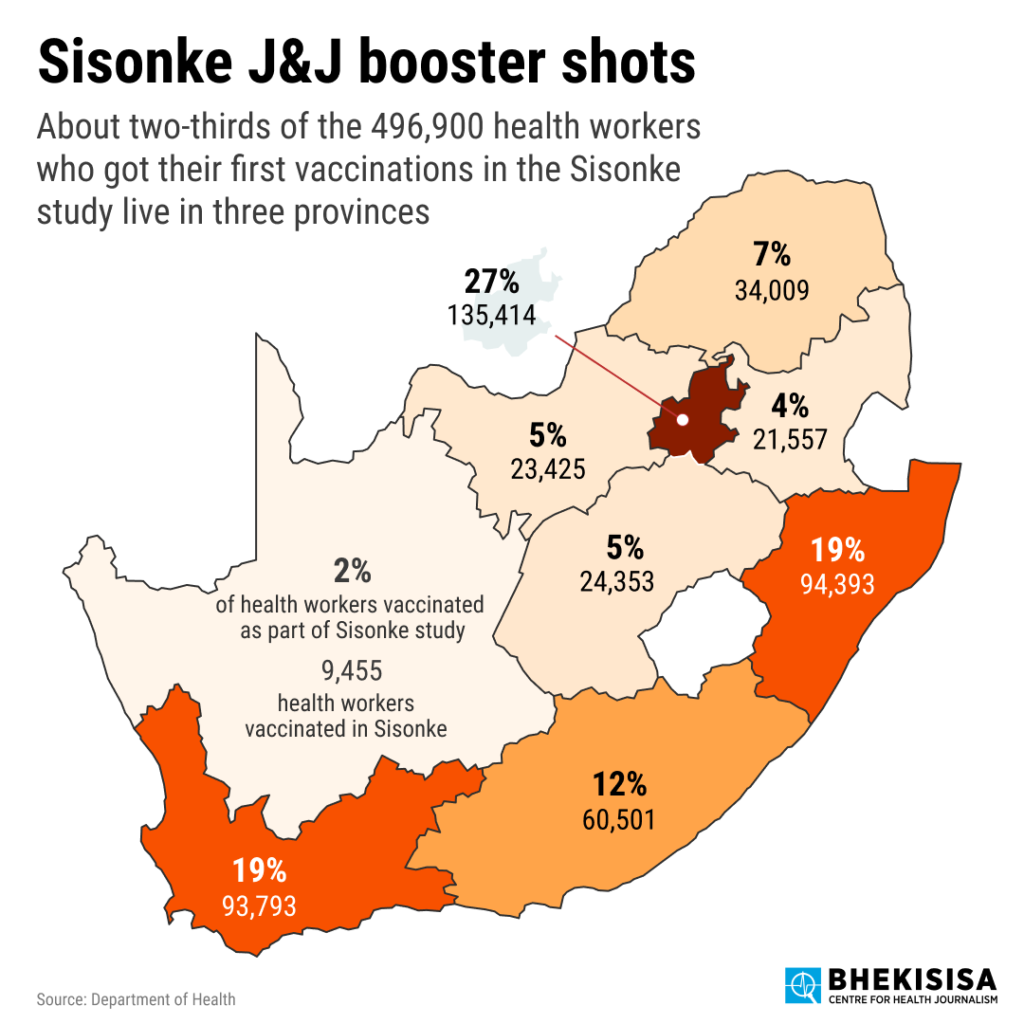
These doses are being provided through a new leg of the study, which volition terminate on 17 Dec.
The Sisonke report ran from February to May and immunised 496 900 healthcare workers with J&J's COVID jab. The programme used leftover stock from J&J'southward international vaccine trials and ran at a time when South Africa had no other jabs available. The local written report's goal was to provide protection to Due south Africa's frontline workers.
Sahpra on 29 October approved a submission past Sisonke's researchers, according to Sahpra's chief executive officer Boitumelo Semete-Makokotlela. The regulator's task was to review the data and to determine whether it is safe and potentially effective for the trial's participants to go another shot up to eight months after their start jab.
What is a booster shot?
Each COVID vaccine comes with its ain recommended dose.
For case, the J&J jab requires only i dose which means, at this stage, that you are considered fully vaccinated after merely one shot. Meanwhile, those who get the Pfizer vaccine are only considered completely immunised after getting two jabs.
Simply, some countries such every bit the United states and Israel, accept decided to give an extra shot to some of those who are already fully vaccinated. These actress doses are called "booster" shots, as they are additional jabs given to people already fully immunised.
For now, boosters are more often than not given to specific groups of people. Extra shots are especially important for people who accept weakened immune systems, such every bit people who have undergone a bone marrow transplant or who are lx years or older.
People who take had organ transplants use medication that suppresses their immune systems to prevent their bodies from rejecting the organs and older people's allowed systems respond less finer to strange invaders in their bodies than those of younger people.
Such individuals may therefore not exist able to build up enough protection later receiving the standard number of vaccine doses.
How long do COVID vaccines protect you?
Waning immunity is not a new concept — it besides may non exist a reason to panic.
Babyhood vaccines, such as jabs used for protection confronting measles and mumps, have shown a yearly drib of between 3 and x% in the amount of antibodies that people produce against those diseases later vaccination.
In the example of COVID, vaccines protect people against getting very sick with the affliction, but we don't notwithstanding know how long that protection lasts and the forcefulness of the protection remains unclear.
For the Pfizer vaccine, there'due south some data that shows people are protected against symptomatic COVID for most half-dozen months later on having received two shots, but scientists don't even so know for certain whether the fact that people produce fewer antibodies confronting SARS-CoV-ii (the virus which causes COVID-19) vi months after they had been fully immunised with certain jabs, translates into weaker protection against the virus.
Hither's why researchers don't nevertheless have an answer for this.
Your immune system consists of circuitous defense force systems and some of these responses become weaker every bit time moves on after vaccination. Each office of your system is responsible for a different type of attack on foreign invaders such as viruses or bacteria.
Spotter: How vaccines can assistance train your immune system
Your immune system produces two types of cells to become rid of germs, attack them and to kill off infected cells. They are chosen B cells and T cells.
B cells make antibodies which fight against the invading germ. T cells, on the other paw, fight and remove cells which take already been infected past the invading germ. When you're exposed to SARS-CoV-two, your body has to fight off the virus using these internal defence force systems.
Your immune organization's ability to "recollect" germs it's run into in the past is an important role of why vaccines are so successful.
Back in May, a grouping of Australian researchers published a paper in Nature Medicine predicting that after viii months the protection provided past COVID vaccines against infection would drop — but they would still be protected from severe disease.
That'southward considering of memory cells, which can be T or B cells, merely we're only looking at B memory cells in this commodity.
Memory B cells make antibodies when they come across a familiar foe. Although the number of antibodies people produce may decrease from about half dozen months afterward vaccination, memory cells usually stick around for longer.
- READ MORE: Three for three: Agreement the 3 COVID variants circulating during SA's 3rd wave
An October newspaper in Science constitute that memory B cells triggered by mRNA vaccines increased six months later on people had been fully immunised. This protection too held stiff for the Alpha, Beta and Delta variants of the virus. The mRNA COVID jabs on the market are Pfizer and Moderna's shots (Due south Africa uses Pfizer).
The increase of retentivity cells over time in those who take been vaccinated seems to mirror similar findings in people who were naturally infected with SARS-CoV-two and recovered from COVID. In a February report in Science, their antibodies had begun dropping eight months after infection, but retention B cells increased.
So even though people may be losing some antibodies a few months after vaccination, information technology doesn't necessarily hateful that the jabs aren't doing their chore.
In summary: Your immune system has many unlike prongs through which to protect you and antibodies are only one function of that. The long-lasting presence of retention B cells and the continued protection vaccines grant against severe disease ways that boosters may not be entirely warranted only yet.
How does a country decide if they demand boosters?
The need for boosters depends on what a country's COVID outbreak looks like and which vaccines are in utilise.
The World Health Organisation (WHO) says there are 3 things nations should look at when considering booster shots.
The first is waning immunity.
The second factor the WHO says countries should look at when they decide if they need boosters pertains to how long vaccines protect people against specifically mild forms of COVID infection — in other words, the likelihood of getting infected with SARS-CoV-ii. About of the research that looks at protection against balmy COVID has, so far, been conducted in unvaccinated people.
What scientists now need to detect out is how well vaccinated people are protected against mild COVID disease and if that protection changes over time.
But statistics nearly breakthrough infections are promising. Quantum infections are infections which occur in vaccinated people, then it's when people get infected with SARS-CoV-2 despite having received a COVID jab.
[Watch] What are breakthrough infections?
Information from England shows one Pfizer jab offers 36% protection confronting mild infection from the Delta variant and two shots reduce your chances of infection past 88%.
The Delta variant is the form of the virus which is currently dominant in South Africa.
Existent life data from the US government'due south Centres for Illness Control (CDC) reveals that fully vaccinated people are five times less likely to become infected with the Delta SARS-CoV-2 variant than those who are unvaccinated.
Lastly, the WHO says, governments must consider the ideals of supplying booster jabs to their populations when much of the developed world is however waiting for jabs to complete round one of their roll-outs.
"Offering booster doses to a large proportion of a population when many accept not even so received even a first dose undermines the principle of national and global equity," the WHO warns.
Southward Africa has bought enough doses to immunise 40-meg people and has fully vaccinated 19.5% of its population so far.
What is happening with COVID in countries that are rolling out boosters?
In July, Israel became the first country to introduce COVID boosters for those over 60. Less than a month later, the extra shots were available to anyone over 30. When the land started to curlicue out boosters, 62% of the population had been fully vaccinated, nonetheless at that place was a surge of COVID cases.
Scientists were concerned that the rising in infections was because of the highly infectious Delta variant circulating in the state and the fact that the protection offered by vaccines was possibly waning.
An August preprint study from State of israel showed that immunity had begun dropping in vaccinated people six months later on they had been fully immunised.
- READ More than: Rise of the variants: What you need to know nigh the Delta variant in SA
More Israel data was published in the New England Journal of Medicine (NEJM) in October, showing that half dozen months afterwards a second Pfizer vaccine jab, the immune system's antibody response substantially decreased, especially among trial participants who were men, people older than 65 and those with weakened allowed systems.
They as well found that antibiotic levels were stronger in people who had previously recovered from COVID and so gotten 2 Pfizer shots compared to those who had never been naturally infected and only been vaccinated. This, researchers contend, could possibly signal the benefit of people receiving a third booster shot.
What do we know almost boosters?
In October, data from this booster roll-out was published in the NEJM. State of israel'south approach to giving tertiary doses of Pfizer's vaccine helped lower the chances of people getting infected with SARS-CoV-2 and developing severe illness.
The NEJM paper shows that 12 days later receiving the third shot, people over sixty were almost 20 times less probable to develop severe COVID than those who had gotten the standard two-dose vaccine. Report participants who received boosters had been fully vaccinated at least five months prior.
Following Israel'due south lead, several countries began rolling out booster programmes.
- READ More: An inconvenient truth: The real reason why Africa is not getting vaccinated
In September, the US Food and Drug Administration (FDA) approved a tertiary Pfizer shot for everyone aged 65 and older, besides as for those who may be younger but at high risk for severe disease.
In October, the FDA also cleared Moderna and J&J COVID vaccines to be used as booster shots. (The Moderna vaccine is not part of South Africa's vaccine roll-out.)
Moreover, the US regulator approved the "mix and match" use of vaccines. That means people who received Pfizer's 2-dose vaccine initially would be able to get a J&J or half a dose of Moderna vaccine for their third dose.
Those who got J&J'southward one-dose vaccine can likewise be given one Pfizer shot as their 3rd dose.
Third doses should exist administered at least two months subsequently a person has been fully vaccinated with ane dose of J&J, or six months after 2 doses of Pfizer, the statement reads.
This decision followed data from a preprint report which showed that people who started off with a J&J shot were better off with a Pfizer or Moderna jab equally their booster.
For people who had Pfizer or Moderna in the offset round of vaccinations, it didn't make much of a difference whether they got a J&J, Pfizer or Moderna booster – they all worked equally well.
South Africa's health minister, Joe Paahla, said in Oct that the health section will offer Pfizer jabs equally 2nd doses to people from S Africa who had received a first jab of the Moderna or AstraZeneca vaccines in a different country.
Update: 2021/10/29 13:40 This article was updated to reflect that South Africa's medicines regulator approved an updated written report protocol submitted by Sisonke researchers. Health workers vaccinated as part of the report will now be eligible for a booster dose of the J&J vaccine from viii Nov.
Please note: On 23 Feb 2022 fully vaccinated people over the age of 18 can get a booster dose. People tin can now become a booster vaccine two months after their first Johnson & Johnson jab or 3 months afterward their second Pfizer shot. The health section now allows a "mix and friction match" approach to boosters, which ways people tin can choose Pfizer of J&J regardless of their previous shots. Teenagers are not eligible for a booster.


Joan van Dyk
Joan van Dyk is a senior health journalist at Bhekisisa.
How Early Can Baby Get 12 Month Shots
Source: https://bhekisisa.org/article/2021-10-28-booster-basics-will-south-africans-need-an-extra-covid-shot/
0 Response to "How Early Can Baby Get 12 Month Shots"
Postar um comentário